
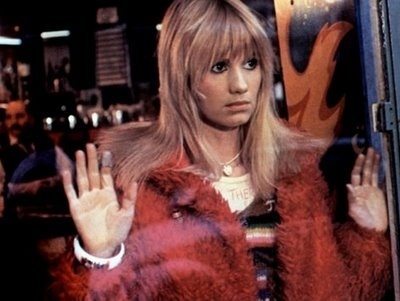
As a youth, I kept my eyes on new movie Sirens before I even employed that term, and I can now mention one of them who symbolically took my hand and plunged my psyche into the confusing world of sex. I was maybe 13 or 14 years old when I watched on the late show D’amour et d’eau fraîche, a seemingly insignificant French movie starring pop singer Julien Clerc and sensual nymph Miou-Miou, who became some sort of imaginary girlfriend. Of course, I subsequently admired her in Les valseuses, On aura tout vu and La dérobade, among others, becoming quite an inspiration in my then clumsy attempts at fiction writings.
There was something about Miou-Miou that made you feel like it would be possible to easily meet her and hang out… without any trouble, without any hassle. Yes, she was not an unreachable glamorous Hollywood star, but her appeal remained in her friendliness and quiet charm. Even debuting in movies where she took her clothes off quite a lot in her own casual way, Miou-Miou became quite an accomplished comédienne. She’s one of the main reasons if, decades later, I started writing about actresses, mainly those that should be worthy of more praise. Born Sylvette Héry on February 22, 1950, in Paris, France, that young woman had no intention in starting a career in show business at first. In fact, she used to sell strawberries at the market, quite a sensational occupation. A story tells that humorist Coluche nicknamed her ‘Miou-Miou’, as she was always seen as a quiet, friendly and clean person and possibly referring to the miaow sound cats make.
Coluche himself and colleague Romain Bouteille founded in 1968 the Café de la Gare, an improvisational theatre that became the training ground for future French acting superstars like Gérard Depardieu, Patrick Dewaere, Thierry Lhermitte and Josiane Balasko among many others, and is still in operation to this day. Bouteille asked Miou-Miou to come work at the Café, where she began as a cleaning lady, then a dresser, then finally an actress. In 1971, she made her film debut in a short starring the main players of the Café at the time, La vie sentimentale de Georges le tueur. She began a liaison with Dewaere, with whom she eventually gave birth to a daughter in 1974, but they broke up soon after.
Miou-Miou made her feature movie debut in La cavale, still in 1971. At first, she soon became an expert at playing blonde demoiselles, often dumb but with a charming naïveté, present in dramas like Les granges brûlées or immortal comedies like Les aventures de Rabbi Jacob, rubbing elbows with screen legends like Jean Gabin or Louis de Funès. She even found time to work with immortal horror movie icon Peter Cushing for the vampire comedy Tendre Dracula. But 1974 remains the year when she became a household name, co-starring with Depardieu and Dewaere in Les valseuses (known as Going Places in the USA), a breath of fresh air in French cinema, a film that gave the opportunity to discover some new talent, new attitudes and an almost off-handed way to film sex scenes. As a young hairdresser who never had an orgasm, Miou-Miou is naked most of the time and her distinct charm is already established. Les valseuses was a big hit critically and at the box-office, on an international level. The three main players were then now seen as the new generation of French movie stars, prophecy that proved to be right for the rest of the seventies and beyond (well, for some of them).
Consequently, Miou-Miou got offered leading parts, alternating between comedy and drama with equal ease, always displaying that mix of youthful innocence and unexpected inner strength. She began a relationship with Robert Charlebois, one of Québec’s key French-speaking singer. They even starred together in one of the last spaghetti western, Un génie, deux associés, une cloche (US title: A Genius, Two Friends, and an Idiot), produced by Sergio Leone which included in its cast Terence Hill, Klaus Kinski and Patrick McGoohan. Don’t you believe at first that Miou-Miou is the above-mentioned Idiot… She soon gave birth to another daughter, this time the fruit of an union with another singer, namely Julien Clerc, with whom she acted in D’amour et d’eau fraîche in 1976, the movie that changed my life, in a sense. In it, she plays a charming bohémienne prostitute, who becomes the main sparkle in the eyes of a young man, much to the chagrin of the latter’s older female lover. As stated before, this movie had quite an emotional impact on me, for Miou-Miou’s physical presence, her astonishing performance and the devastating emotional finale, not unlike the one in Love Story, if you get my meaning.
From then on, girlfriendless me began to imagine that this was the kind of relationship I wanted with a female companion (not counting the tragic finale, of course) and I began a trek in my vivid imagination to fill that void. My fiction writing began to change, adopting new tones of bittersweet melancholy. My attitude towards sex began to change also, becoming more realistic, with a new sense of romance and sharing. In short, I was maturing, I guess… and I owed it all to D’amour et d’eau fraîche, particularly Miou-Miou, in a now quasi-forgotten little romantic movie. So thank you once again, Sylvette Héry. And believe it or not, I have not seen that movie again since then… but it’s permanently imprinted in my brain, and I don’t know if I should ever view it again, if ever the opportunity arises, to keep the mystique alive.
There were other unforgettable ‘70s roles, mainly in the excellent dark farce Pas de problème! and the Pierre Richard comedy On aura tout vu concerning porn films. F… comme Fairbanks was interpreted as a version of her liaison with Patrick Dewaere. Jonas qui aura 25 ans en l’an 2000 was seen as a masterpiece in European filmmaking. Dites-lui que je l’aime was another emotional love story. Then came La dérobade, which is another milestone in my life (delicate US title: Memoirs of a French Whore).

In 1979 in Québec, the movie rating system was quite simple with three choices: All access, 14 years and up and 18 years and up. Because of its subject matter, La dérobade was 18 years and up. Since I was barely 15 at the time but already quite tall, this remains the first movie that I’ve seen when I lied about my age. Quite a scandal. The movie’s story centers around a young girl who gets dragged down by an unscrupulous boyfriend into the world of prostitution. Now this isn’t Pretty Woman, the script is not about glamour and glitz and cheap sex thrills, but the sad and ugly truth of the business. Miou-Miou is of course excellent, to the point of winning that year’s Best Actress award at the César ceremony. Oddly, she refused the honor, believing that artists should not compete against each other for such galas. To date, she has been nominated nine times, so what’s to say?
In 1982, actor and former romantic partner Patrick Dewaere gave an uplifting interview with local Québec talk-show host Michel Jasmin, in Paris. The day after, July 16, Dewaere took his own life by shooting himself, as he was working on Claude Lelouch’s film Édith et Marcel. This tragedy became like a turning point in French cinema, and was mourned in all French-speaking countries and beyond. If Gérard Depardieu is still considered internationally as France’s greatest actor, for my money Dewaere had the biggest talent, playing more troubled and unhinged characters (see his breakdown in Liste noire for example), which maybe reflected on his inner demons.
Miou-Miou was also excellent in 1980’s La femme flic and soon after acted in one of Lee Marvin’s last film, Canicule. She continued to work, but more and more sporadically. For some unknown reasons, I began to detach myself from her presence, as adult life was calling me to grow up, for better and for worse, but still cherished her influence on me. There was personal triumphs in Tenue de soirée and La lectrice in the later eighties, and then soon for La totale!, for which the American version became Arnold Schwarzenegger’s True Lies, Jamie Lee Curtis playing the Miou-Miou character. In 1993, Germinal was also a courageous and gritty performance. But getting close to her 50th birthday, of course movie roles became more rare and she returned with joy to the theater. As she never considered herself a star, this wasn’t felt as a step backward. But she still pops up in films, lately in 2006’s Le héros de la famille. Her eldest daughter writes scripts and the youngest is now an actress.
There’s a couple of scenes in La dérobade that still haunts me. There’s one of the Marie character that becomes so desperate in her need to make money that she repeatedly bangs her head against a square of glass, bang bang bang, until she actually breaks it with her forehead and hurts herself. This is simply heart-shattering. The other scene is a more quieter moment, when we see Marie waiting quietly for an eventual client, all pretty with a flower on her head, bathed by a warm, reddish glow. This is Miou-Miou, probably my favorite actress of all time, for many reasons. This is Miou-Miou, the exceptional acting talent. This is Miou-Miou, my first muse in the confusing world of changing hormones. I will never forget her. I can never forget her.
Filmography
1971 La cavale 1973 Quelques messieurs trop tranquilles; Elle court, elle court la banlieue; L’an 01; Themroc; Les granges brûlées; Les aventures de Rabbi Jacob 1974 Les valseuses; Tendre Dracula 1975 Lily, aime-moi; Pas de problème! Un genio, due compari, un pollo 1976 Al piacere di rivederla; La marche triomphale; D’amour et d’eau fraîche; F… comme Fairbanks; On aura tout vu; Jonas qui aura 25 ans en l’an 2000 1977 Dites-lui que je l’aime 1978 Les routes du sud 1979 Le grand embouteillage; Au revoir à lundi; La dérobade 1980 La femme flic 1981 Est-ce bien raisonnable?; La gueule du loup 1982 Josepha; Guy de Maupassant 1983 Coup de foudre; Attention! une femme peut en cacher une autre 1984 Blanche et Marie; Canicule; Le vol du sphinx 1986 Tenue de soirée 1988 Les portes tournantes; La lectrice 1990 Milou en mai 1991 Netchaïev est de retour; La totale! 1992 Le bal des casse-pieds 1993 Tango; Germinal 1994 Montparnasse-Pondichéry; Un indien dans la ville 1996 Ma femme me quitte; Le huitième jour 1997 Nettoyage à sec; Elles 1998 Hors jeu 2000 Tout va bien, on s’en va 2004 Folle embellie; Mariages!; L’après-midi de monsieur Andesmas 2005 L’un reste, l’autre part; Riviera 2006 La science des rêves; Avril; Le héros de la famille 2007 Les murs porteurs 2008 Affaire de famille; Le grand alibi; Pour un fils
Check out these other Siren profiles:







Submit your review | |