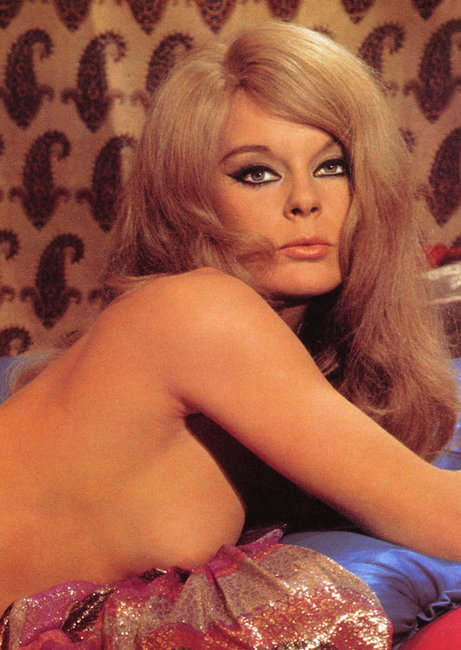
It’s now time to pay tribute to blondes! Oddly, not many of our guests can claim to sport wheat-colored hair, so here I introduce… Paula Schultz! Huh? Can’t remember her? The Wicked Dreams of Paula Schultz is an inane war comedy that used to be on TV a million times in my youth and it’s via this film that I met our new Siren, the friendly Elke Sommer. Now, that was an odd title for a very innocent script, which tried to be a more risqué adaptation of the popular TV show Hogan’s Heroes (even Bob Crane was the leading male star). My memory can still recall the view of Elke wearing black underwear, ready to jump over the Berlin Wall using a pole. I found myself charmed by her unmistakable pixie features. Considering that Elke Sommer worked on many B-movies (most memorably with a couple of weird Mario Bava projects), her inclusion here becomes essential (not to mention the benefit of her reputation as a top sex-symbol of the sixties).
Our main character was born in Berlin, on November 5, 1940, under the name Elke Schletz. Considering her family origins, she could still claim to be a baroness, but she never choose to present herself so. After WWII, her now-impoverished family found itself on the west side of the city and the father would leave for a better world when Elke was 14. The young girl’s favorite lessons were inclined toward linguistic studies, as she learned Latin and Greek for many years at the prestigious Gymnasium School. In time, her facility with different languages resulted in the mastery of seven of them. She found work and continued studying in England, enjoying a four dollars salary per week and thus improving her English.
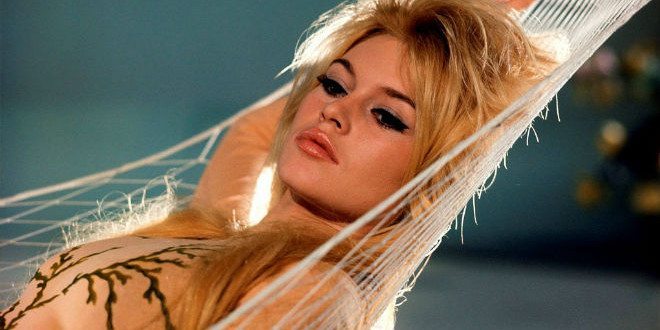
While on vacation with her mother in Italy, Elke was offered a role in a Vittoria De Sica movie, nothing less. But what kind of role? As a German tourist, of course! Splendid timing! So, even before turning 20, Elke could be seem in a dozen of roles in Italian and German productions. These lightweight comedies introduced us to a ravishing lingerie-wearing (or sometimes nude) debutante, as Europe still shook under the Brigitte Bardot Phenomenon. Many young European starlets of the big screen regularly showed skin (be it by baring a bare back or just a side view of a breast). America could not compete in this new kind of cheesecake, as couples were still shown sleeping in separate beds! Elke also worked with Max Pecas, a pioneer of European soft-core, in Daniela By Night, which proclaimed that the measurements of its lead actress were 36-23-37. Soon after, Elke was officially invited to work in England.
Her English language debut was Don’t Bother to Knock, with her name on big letters on the official poster. The movie would reach the US shores three years later (1964) under the title Why Bother to Knock?, an astonishing title change for a simple romantic comedy. Other movie fluff was waiting back home in Germany. 1963 remains an important year for our actress, as she took part in her first Hollywood production, The Victors (even if shooting took place in England). She would come to California right after to accept a role in The Prize, alongside Paul Newman.
The only thing missing at that point was a big international movie success. Happily, such an opportunity would manifest itself. The title? A Shot in the Dark, second entry in the hilarious Pink Panther series, with Peter Sellers as clumsy Inspector Clouzot. Busy girl-chaser Sellers would even ask her to be his wife, as Elke had just united her life with writer Joe Hyams. She would beat Ursula Andress and Tippi Hedren at the 1964 Golden Globes for Most Promising Female Newcomer. Hollywood successfully convinced a reluctant Elke to have dental surgery to close a gap between her front teeth… the prize of perfection! Amazed at even be considered a sex-symbol, Elke would mainly work the following years in American productions.
Some titles: The Art of Love, The Money Trap (alongside Rita Hayworth suffering from poor health), The Oscar (a camp classic that must be seen once to enjoy its complete dumbness), Boy Did I Get a Wrong Number! (with Bob Hope), Deadlier Than the Male (one of her best movies, a spy thriller reintroducing the character of Bulldog Drummond), and The Venetian Affair, with Boris Karloff as Doctor Pierre Vaugiroud (huh? Karloff playing a Frenchman?).
Unlike some present and future guests on this website, Elke never had the privilege to share the screen with Elvis, but at least she could claim to work alongside my favorite debonair movie drunk, Dean Martin, in an episode of his Matt Helm series, The Wrecking Crew. Elke would next find herself in Zeppelin (and in an actual zeppelin), with Michael York, considered to be another good role. Then came her first shooting under Mario Bava’s direction, for Baron Blood. Bava was delighted to talk in Italian with his leading lady. She still considers him one of her favorite directors. They would be reunited for House of Exorcism (which is also known under varying titles and versions), with Telly Savalas. In some scenes, Elke is possessed by the Devil, as she screams obscenities and various disgusting critters also come out of her mouth.
In 1970, Elke posed for Playboy, in a seven-pages pictorial photographed by her spouse containing classic images, to say the least. After shooting an adaptation of Agatha Christie’s Ten Little Indians (with Charles Aznavour), Elke’s acting career began to lose momentum. No more big-budgeted Hollywood productions, as she found herself in European B-movies not really known in North America (this mostly holds true from the eighties forward). At least, she was invited to participate in a Carry On film, Carry On Behind, playing Professor Anna Vrooshka.
With time, Elke became interested in theatre, eventually becoming director. Sadly, while performing in Chicago, she lost twins in her sixth month of pregnancy. A new passion came her way, that of painting, her principal artistic inspiration to this day. Elke would hold her first exposition in 1978. Her movie appearances became more and more sporadic but, out of the blue, she was cast in a Fangoria magazine production titled Severed Ties, a 1992 horror picture.
It’s still odd today to notice how many people consider Elke as an actress of limited talent and appeal, to the point of identifying her with one of her many dumb blonde characters of the past. Let’s not forget the bright and cultured woman (seven spoken languages, remember?) that now seems at peace with life and still looks like a teenager in her sixties. Too often under-estimated an an artist, my goal here was to pay homage to Paula Schultz, to prove that any bad movie can still be of some importance in any lifetime.
Filmography
1958 This Angry Age 1959 L’amico del giaguaro; La pica sul Pacifico; Ti diro… che tu mi piaci; Uomini e nobiluomini; Howlers of the Dock; Ship of the Dead; The Jukebox Kids; The Day the Rains Came 1960 Lampenfieber; Himmel, Amor und Zwirn; The Warrior Empress; Love Italian Style 1961 Geliebte Hochstaplerin; Und sowas nennt sich Legben; Auf Wiedersehen; Daniella By Night; Don’t Bother to Knock; 1962 Cafe Oriental; Das madchen und der staaltsanwalt; Bahia de Palma; Violent Ecstacy; Un chien dans un jeu de quilles; Who Stole the Body? 1963 The Prize; The Victors; Denn die musik und lie liebe in Tirol; Seduction By the Sea 1964 A Shot in the Dark; Seven Tons of Gunfire; Among Vultures 1965 The Art of Love; The Money Trap; Hotel der toten Gaste; Le bambole 1966 Boy, Did I Get a Wrong Number!; The Oscar; Deadlier Than the Male 1967 The Venetian Affair; The Corrupt Ones 1968 The Wicked Dreams of Paula Schultz; The Invincible Six; They Came to Rob Las Vegas 1969 The Wrecking Crew 1971 Percy; Zeppelin 1972 Baron Blood 1973 Die reise nach wien; One or the Other of Us 1974 And Then There Were None; House of Exorcism; Percy’s Progress 1975 Carry On Behind; The Swiss Conspiracy 1976 Invisible Strangler; Das netz; One Away; Meet Him and Die 1978 I Miss You, Hugs and Kisses 1979 The Prisoner of Zenda; The Double McGuffin; The Treasure Seekers; A Nightingale Sang in Berkeley Square 1980 Exit Sunset Boulevard 1981 Der mann im pyjama 1984 Cathy 1985 Lily in Love 1986 Death Stone 1987 Adventure Beyond Belief 1989 Himmelsheim 1992 Severed Ties 1996 Dangerous Cargo; Alles nur Tarnung 2000 Flashback – Morderische Ferien 2010 Das Leben ist zu lang
Please visit our friends at CasinoSitesUSA.com, whom we thank for supporting the CultSirens.com website!
&nbps;
Check out these other Siren profiles:




Submit your review | |